
• support@parceltraceglobal.com
  • 121 WallStreet Street, NY York, USA

Get In Touch

90 154 456 784

Awesome Image

A new reality for cross-border trade

At the World Economic Forum in Davos this year, Canadian Prime Minister Mark Carney didn’t mince words about the future of U.S.-Canada trade.

“Let me be direct,” said Carney. “We are in the midst of a rupture, not a transition. Our old relationship with the United States—a relationship based on steadily increasing integration—is over.”

Over the past two decades, Carney added, crises across finance, health, energy, and geopolitics have exposed the risks of extreme global integration. More recently, those risks have taken on a sharper edge. “Great powers are now using economic integration as a weapon—tariffs as leverage, financial systems as coercion, and supply chains as vulnerabilities to be exploited.”

As if cross-border transportation in North America weren’t already complex enough, recent legal and policy developments have added another layer of uncertainty. A landmark Supreme Court ruling in February sidelined key elements of the Trump administration’s original tariff framework, contributing to an evolving patchwork of rules that continues to shift.

The result: a more opaque and unpredictable environment for U.S.-Mexico-Canada trade.

Even the mechanics of tariff refunds remain unclear. As importer of record, FedEx is obligated to pass along any refunds to customers who shared in those costs—but how and when that happens is far from settled.

“Who actually gets paid back—and through what process—will have to be worked out contract by contract,” says Geoffrey Gertz, senior fellow at the Center for a New American Security. “And it will likely involve a lot of billable hours.”

At a time when diplomatic relations with key trading partners are under strain, the question for shippers is no longer just how to move freight across borders—but how to operate in an increasingly uncertain and fragmented trade environment.

World’s largest trading partners in a spat

Canada and the United States maintain one of the world’s largest trading relationships. Canada remains the largest buyer of U.S. exports and the second-largest source of imports behind China, according to the U.S. Trade Representative.

But where the relationship goes from here remains unclear.

One recent flashpoint: a rule enacted last November placing a 25% tariff on medium- and heavy-duty trucks imported into the United States. The policy applies broadly across vehicle categories, including delivery trucks, transit buses, and tractor-trailers.

There are exceptions. Vehicles and parts that meet United States-Mexico-Canada Agreement (USMCA) requirements are exempt, with tariffs applying only to non-U.S. content value.

To offset the impact, the Trump administration introduced a manufacturing incentive providing a tariff credit equal to 3.75% of the aggregate value of U.S.-assembled trucks from 2025 through 2030.

For carriers, however, the net effect is clear: higher costs. Analysts estimate the price of a new Class 8 tractor could reach roughly $212,000—and closer to $238,000 when combined with the 12% federal excise tax.

The international response has been swift. Mexico’s Economy Ministry has argued that the tariff conflicts with USMCA provisions and has signaled plans to pursue adjustments tied to U.S. content levels in Mexico-built vehicles.

All of this comes as the U.S., Mexico, and Canada begin the formal review process for USMCA, scheduled to conclude July 1, 2026. The U.S. Trade Representative has requested public input on how the agreement can be strengthened to enhance North American competitiveness.

Early discussions between U.S. Trade Representative Jamieson Greer and Mexico’s Economy Secretary Marcelo Ebrard have focused on supply chains, rules of origin, and trade dependencies. Talks with Canada are moving on a different track, with officials expressing cautious optimism about targeted updates rather than a full renegotiation.

Meanwhile, industry groups—from retail and consumer goods to automotive and apparel—are urging policymakers to maintain duty-free treatment for compliant goods and preserve trilateral cooperation.

“Canada and Mexico are huge markets for American consumer packaged goods,” says Tom Madrecki, vice president of supply chain at the Consumer Brands Association. “Maintaining duty-free trade under USMCA is critical to continued growth.”

How to work cross-border fine print

The first thing cross-border shippers in and out of Mexico must realize is solving the historical challenge stemming from the operational imbalance in terms of volumes from a north-south perspective.

Basically, what one should remember is there are three loads north for every one load south. “That imbalance causes waste,” says Frank Bateman, Ryder System vice president of supply chain solutions. “In many cases, you have to dead-head south and that causes waste.”

The complexity doesn’t stop there. Cross-border shipments often involve multiple parties across both countries—from carriers and customs brokers to drayage providers and distribution centers.

“That’s a lot of moving parts,” Bateman says. “As a 3PL, our job is to ensure visibility across all of them. Getting everything in sync is critical because the margin for error has really shrunk.”

Ryder managed more than 280,000 cross-border moves last year, a 10% increase. But success at the border, Bateman emphasizes, isn’t about speed alone. “It’s about coordination and discipline.”

To manage that complexity, Ryder uses value stream mapping to define responsibilities, streamline communication, and ensure alignment across stakeholders. In many cases, the flow of information is just as critical as the movement of freight.

“The first requirement is discipline,” Bateman says. “Customs documentation isn’t optional. There’s no margin for error. If processes break down, you’re dealing with delays—or worse, cargo seizures.” In short, cross-border freight rarely fails in transit. It fails in planning, paperwork, and execution.

Bateman also stresses the importance of programs like Customs-Trade Partnership Against Terrorism (CTPAT), which helps trusted shippers improve security while accelerating clearance.

“Joining CTPAT is essential,” says Bateman. “And you need redundancy—enough equipment and resources at the border to handle disruptions when they happen.”

Closings at the border

Late last year, Laredo, Texas-based Texas International Enterprises—a major cross-border carrier—filed for Chapter 11 bankruptcy, laying off 600 drivers.

The company reported up to $50 million in liabilities, more than 200 creditors, and no funds for unsecured claims. After logging 39 million miles in 2024, it was suddenly gone.

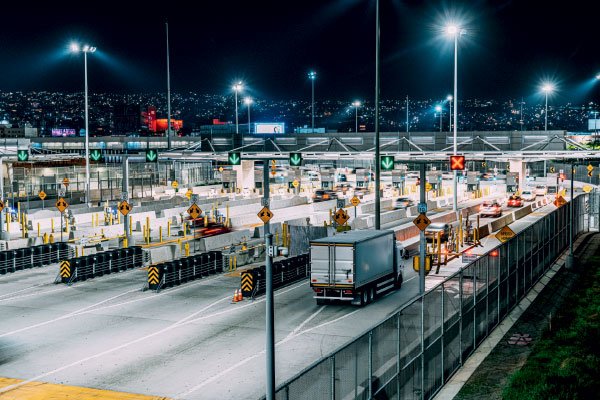
The location matters. Laredo is one of the most critical gateways for U.S.-Mexico trade. When operations falter there, the implications ripple across the entire supply chain. “A trucking company shutting down in Laredo at this point in the year should be setting off serious warning signals,” one driver said.

Across the market, drivers report similar trends: fewer trucks on the road, faster loading times, and weaker seasonal demand. For many smaller operators—particularly owner-operators—those pressures are becoming increasingly difficult to absorb.

At the same time, consolidation continues, with larger carriers and private equity-backed firms gaining share. Layered onto that is a broader geopolitical shift. Both Mexico and Canada are exploring new trade partnerships, signaling a willingness to diversify beyond traditional U.S.-centric relationships.

“We understand that this rupture calls for more than adaptation,” Carney said in Davos. “It calls for honesty about the world as it is. The old order is not coming back—and nostalgia is not a strategy.”

Leave A Comment

Recent News

Awesome Image

Cargo & Logistics Business Services

Contact Now
We use cookies to personalise content and ads, to provide social media features and to analyse our traffic. We also share information about your use of our site with our social media, advertising and analytics partners.
Cookies settings
Accept
Privacy & Cookie policy
Privacy & Cookies policy
Cookie name Active

Privacy Policy

What information do we collect?

We collect information from you when you register on our site or place an order. When ordering or registering on our site, as appropriate, you may be asked to enter your: name, e-mail address or mailing address.

What do we use your information for?

Any of the information we collect from you may be used in one of the following ways: To personalize your experience (your information helps us to better respond to your individual needs) To improve our website (we continually strive to improve our website offerings based on the information and feedback we receive from you) To improve customer service (your information helps us to more effectively respond to your customer service requests and support needs) To process transactions Your information, whether public or private, will not be sold, exchanged, transferred, or given to any other company for any reason whatsoever, without your consent, other than for the express purpose of delivering the purchased product or service requested. To administer a contest, promotion, survey or other site feature To send periodic emails The email address you provide for order processing, will only be used to send you information and updates pertaining to your order.

How do we protect your information?

We implement a variety of security measures to maintain the safety of your personal information when you place an order or enter, submit, or access your personal information. We offer the use of a secure server. All supplied sensitive/credit information is transmitted via Secure Socket Layer (SSL) technology and then encrypted into our Payment gateway providers database only to be accessible by those authorized with special access rights to such systems, and are required to?keep the information confidential. After a transaction, your private information (credit cards, social security numbers, financials, etc.) will not be kept on file for more than 60 days.

Do we use cookies?

Yes (Cookies are small files that a site or its service provider transfers to your computers hard drive through your Web browser (if you allow) that enables the sites or service providers systems to recognize your browser and capture and remember certain information We use cookies to help us remember and process the items in your shopping cart, understand and save your preferences for future visits, keep track of advertisements and compile aggregate data about site traffic and site interaction so that we can offer better site experiences and tools in the future. We may contract with third-party service providers to assist us in better understanding our site visitors. These service providers are not permitted to use the information collected on our behalf except to help us conduct and improve our business. If you prefer, you can choose to have your computer warn you each time a cookie is being sent, or you can choose to turn off all cookies via your browser settings. Like most websites, if you turn your cookies off, some of our services may not function properly. However, you can still place orders by contacting customer service. Google Analytics We use Google Analytics on our sites for anonymous reporting of site usage and for advertising on the site. If you would like to opt-out of Google Analytics monitoring your behaviour on our sites please use this link (https://tools.google.com/dlpage/gaoptout/)

Do we disclose any information to outside parties?

We do not sell, trade, or otherwise transfer to outside parties your personally identifiable information. This does not include trusted third parties who assist us in operating our website, conducting our business, or servicing you, so long as those parties agree to keep this information confidential. We may also release your information when we believe release is appropriate to comply with the law, enforce our site policies, or protect ours or others rights, property, or safety. However, non-personally identifiable visitor information may be provided to other parties for marketing, advertising, or other uses.

Registration

The minimum information we need to register you is your name, email address and a password. We will ask you more questions for different services, including sales promotions. Unless we say otherwise, you have to answer all the registration questions. We may also ask some other, voluntary questions during registration for certain services (for example, professional networks) so we can gain a clearer understanding of who you are. This also allows us to personalise services for you. To assist us in our marketing, in addition to the data that you provide to us if you register, we may also obtain data from trusted third parties to help us understand what you might be interested in. This ‘profiling’ information is produced from a variety of sources, including publicly available data (such as the electoral roll) or from sources such as surveys and polls where you have given your permission for your data to be shared. You can choose not to have such data shared with the Guardian from these sources by logging into your account and changing the settings in the privacy section. After you have registered, and with your permission, we may send you emails we think may interest you. Newsletters may be personalised based on what you have been reading on theguardian.com. At any time you can decide not to receive these emails and will be able to ‘unsubscribe’. Logging in using social networking credentials If you log-in to our sites using a Facebook log-in, you are granting permission to Facebook to share your user details with us. This will include your name, email address, date of birth and location which will then be used to form a Guardian identity. You can also use your picture from Facebook as part of your profile. This will also allow us and Facebook to share your, networks, user ID and any other information you choose to share according to your Facebook account settings. If you remove the Guardian app from your Facebook settings, we will no longer have access to this information. If you log-in to our sites using a Google log-in, you grant permission to Google to share your user details with us. This will include your name, email address, date of birth, sex and location which we will then use to form a Guardian identity. You may use your picture from Google as part of your profile. This also allows us to share your networks, user ID and any other information you choose to share according to your Google account settings. If you remove the Guardian from your Google settings, we will no longer have access to this information. If you log-in to our sites using a twitter log-in, we receive your avatar (the small picture that appears next to your tweets) and twitter username.

Children’s Online Privacy Protection Act Compliance

We are in compliance with the requirements of COPPA (Childrens Online Privacy Protection Act), we do not collect any information from anyone under 13 years of age. Our website, products and services are all directed to people who are at least 13 years old or older.

Updating your personal information

We offer a ‘My details’ page (also known as Dashboard), where you can update your personal information at any time, and change your marketing preferences. You can get to this page from most pages on the site – simply click on the ‘My details’ link at the top of the screen when you are signed in.

Online Privacy Policy Only

This online privacy policy applies only to information collected through our website and not to information collected offline.

Your Consent

By using our site, you consent to our privacy policy.

Changes to our Privacy Policy

If we decide to change our privacy policy, we will post those changes on this page.
Save settings
Cookies settings