
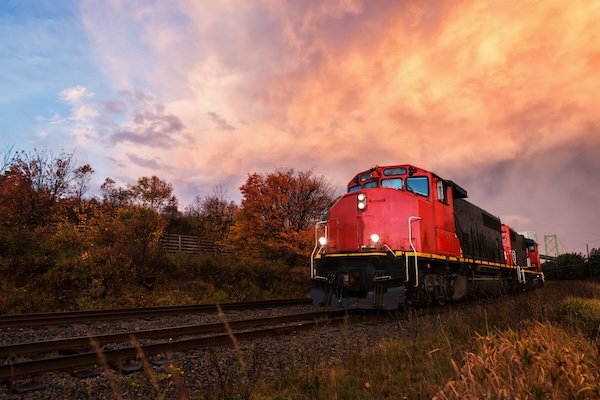
United States rail carload and intermodal volumes remained on a growth track in May, according to the new edition of the “Rail Industry Overview (RIO),” which was recently published by the Washington, D.C.-based Association of American Railroads (AAR).
This free publication is issued monthly by the AAR and provides insights from AAR economists regarding what rail traffic is saying about the current state of the economy, as well as where things may be headed. It also features a Freight Rail Index (FRI), which AAR said “tracks movement across the most economically sensitive rail traffic commodities,” including U.S. carload commodities (excluding coal and grain) and intermodal containers and trailers.
AAR Chief Economist Rand Ghayad told LM that the RIO essentially provides a summary of the key findings from the roughly 45 reports AAR produces for various industry stakeholders, with some of those reports geared toward those in the freight rail industry, as well as policymakers and academics, with data and information coming from what he called a wide range of sources.
“Rail volume or rail traffic data in general is usually seen as a very important and solid indicator of what’s happening in the economy,” he said. “So, if you want to know how the economy is going to be moving over the next couple of months, one way is actually to look at what’s happening in the rail industry. The whole idea of RIO is to summarize the findings from everything we’re putting out there and connect the dots with what’s happening in the economy. If the industry is doing well, it means the economy is on the right track. If the industry is not doing well, it means there are some concerns about how the economy is proceeding. It’s meant to be very easy to digest. It’s not meant to be very technical. It’s not meant to be only for rail folks. It’s meant to be for everybody who’s interested in knowing about the economy, and mostly about how rail drives the economy.”
The April FRI reached its highest level in 17 months, the report noted, adding that it serves as a reinforcement of broader signs of improving goods-sector momentum, with the “breadth of these gains,” being the key takeaway, as growth occurring across much of the rail network often signaling more durable improvements in underlying economic activity.
May U.S. carloads saw a 2.5% annual gain, rising for the fifth consecutive month, coming in at their highest level since 2019, with 15 of the 200 carload commodities it tracks seeing annual gains, with AAR noting that the gains highlight the widespread nature of recent freight strength.
Intermodal volumes headed up 8.1% annually, seeing gains for the fourth consecutive month, with volumes at a record-high, to date, suggesting what AAR called, “continued resilience in consumer-related freight demand and international trade flows.”
“Rail traffic strengthened again in May, extending a pattern that has become increasingly evident throughout 2026,” the report said. “More importantly, growth is becoming broader. Freight gains are no longer concentrated in a handful of commodity groups but are increasingly visible across much of the rail network. That breadth may be the most important signal coming from freight markets today. When growth extends across agriculture, intermodal, chemicals, and other industrial sectors simultaneously, it often points to strengthening underlying economic activity rather than temporary gains in a single market. No single month determines the economic outlook, and risks remain. However, recent rail data continue to suggest that the goods side of the economy is proving more resilient than many headline narratives imply.”
As for the economic outlook, AAR said that it remains subject to several uncertainties, including inflation trends, labor market conditions, trade policy developments, and geopolitical events. Which it said will all continue to shape business decisions, consumer spending patterns, and freight demand in the coming months.
“At the same time, the cumulative signal from rail markets remains constructive,” it said. “Freight growth has become increasingly broad-based, manufacturing activity continues to improve, agricultural demand remains strong, and intermodal traffic suggests consumer-related goods demand remains resilient.”