
The state of private trucking is in “an historically strong position,” driven by its commitment to service and safety—as well as lingering capacity concerns when North American ground freight volumes return to a more “normal” state.
That’s the view of Gary Petty, president and CEO of the National Private Truck Council (NPTC), who points to several factors behind this strength. Chief among them is a renewed commitment from companies that operate private fleets, reinforced by lessons learned during the pandemic and the 2017–2018 freight crisis, when for-hire capacity was scarce.
At the same time, options in the broader for-hire trucking market have narrowed. Large truckload fleets like Celadon shut down in 2019, while former LTL leader Yellow Corp. ceased operations in 2023 after 99 years—eliminating roughly 30,000 jobs.
In total, more than 88,000 trucking companies closed in 2023, the most recent year with full data available. Additional contraction followed in 2024 and 2025, driven by overcapacity, weak spot rates, and elevated operating costs.
“The fact is a lot of for-hire companies have gone out of business or been sold,” says Petty. “Today’s sunshine can mean tomorrow is another freight recession.”
Against that backdrop, assured capacity and high service levels remain the primary advantages of private fleets—particularly for manufacturers and other shippers seeking tighter control over inventory and service performance. “We think private fleets represent a stronger commitment than ever before,” Petty adds. “They still must benchmark against the best, but overall, we see strength and growth.”
With that in mind, here’s our annual deeper dive into the world of private fleets—how they operate, the trade-offs involved, and what lies ahead.
What’s driving private fleet adoption?
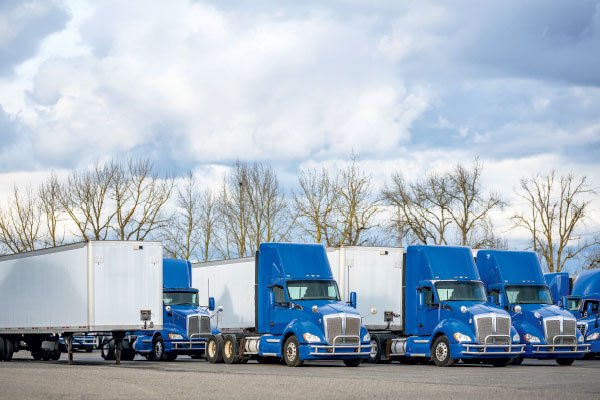
Private fleets are flexing their market strength, capturing a record 75% share of outbound freight movements in 2024, the most recent year with full data available. They continue to position themselves as a value-added transportation solution—whether measured by shipment volume, freight moved, or the overall value of goods hauled.
According to NPTC’s annual survey, private fleet shipments rose 11.7% year-over-year, accelerating from 7.5% growth the prior year and 4.6% the year before that. Freight volume increased 8.2%, slightly below the previous two years but still indicative of steady expansion. The value of private fleet freight movements also climbed, posting a 6.6% year-over-year gain.
“The private fleet industry continues to grow, but the pace may have moderated due to broader economic conditions,” says Tom Moore, senior vice president at NPTC. “At the same time, the share of outbound freight continues to increase, which underscores that growth.”
How large that share truly is remains open to interpretation. The annual State of Logistics report last year estimated the “private or dedicated” segment at $541 billion, up from $528 billion the previous year. But definitions matter—not all dedicated capacity is controlled by shippers.
Still, regardless of how the market is sliced, private fleets are gaining traction.
Some of the biggest names in U.S. commerce—PepsiCo, Walmart, Sysco Corp., US Foods, and Performance Food Group—top the list of the largest private fleet operators. For these companies, the added cost and operational complexity of running a private fleet are offset by the reliability, safety, and service control they provide.
“If you roll back to the freight disruption of 2017–2018, private fleets had a real awakening,” Moore explains. “They realized it was more important to optimize their supply chains—not just their fleets. When they couldn’t secure rates or service in the for-hire market, they decided to take control.”
That shift has moved private fleets from a cost-driven model to a value-driven one. While cost remains a factor, it is increasingly evaluated in the context of total supply chain performance. “That’s the value proposition private fleets offer,” Moore adds.
Service leads the attraction
The primary force behind private fleet growth in the U.S. remains a relentless focus on customer service. At the same time, many large operators are adopting “blended” models—integrating for-hire capabilities into their private fleet operations.
“What we’re seeing is a clear cost justification for private fleets as a hedge against for-hire capacity constraints,” says Moore. “Our members refer to it as ‘captured capacity,’ and it’s a key driver behind continued investment.”
That dynamic is also elevating transportation’s role within corporate strategy. Increasingly, says Petty, private fleets are viewed not just as cost centers, but as competitive differentiators—particularly through their use of advanced information technology.
“It’s a great way to showcase attributes such as sustainability and green practices,” Petty explains. “You’re running safer equipment with the latest technology, while also reducing your carbon footprint. That becomes a strong message in the market.”
As a result, private fleet leaders are gaining a more influential voice in corporate decision-making.
“If transportation doesn’t have a seat at the table because it’s been outsourced, that can become a disadvantage over time,” Petty notes. “With a private fleet, we can help shape those decisions.”
Safety performance is another defining strength. Private fleets tend to retain drivers longer and compensate them at higher levels, with average tenure nearing nine years. Turnover hovers around 18%, compared to roughly 85% in the for-hire truckload sector.
Those advantages come at a cost. Experienced private fleet drivers often earn around $100,000 annually. But operators view that investment through a different lens.
“We wouldn’t call it cost—we would call it risk,” says Petty.
The legal position
One of the more underreported—but increasingly significant—risks facing trucking operations is exposure to fraudulent and staged accident claims.
Industry advocates say for-hire carriers, in particular, are frequent targets, with an estimated 10 to 30 staged accidents occurring each month.
“Managing risk and mitigating exposure is a critical part of fleet operations today,” says Petty. “Private fleets have robust accident mitigation protocols in place to address fraudulent claims and resolve legitimate disputes.”
Recent cases underscore the scope of the issue. In Louisiana, two attorneys were convicted for their roles in staging accidents involving commercial vehicles to generate fraudulent insurance claims and lawsuits.
According to the U.S. Attorney’s Office, the scheme involved individuals—referred to as “slammers”—who intentionally collided with heavy trucks and then fabricated claims. In some cases, participants fled the scene, leaving one individual behind to pose as the driver. The operation also included “spotters,” who actively sought out commercial vehicles to target.
An April 25, 2025, federal indictment detailed how these coordinated efforts led to charges including mail and wire fraud, obstruction of justice, and witness tampering.
The Louisiana Motor Transport Association said its members had been targeted for years by similar schemes, which “inflicted severe financial damage, threatened livelihoods, and tarnished the reputations of professional drivers who did nothing wrong.”
Against this backdrop, legal exposure has become another factor shaping fleet strategy. Large private fleet operators—often backed by significant corporate resources—may be better positioned to defend against such claims than smaller, for-hire carriers.
“That’s one reason companies are strengthening their private fleet capabilities and capturing capacity outside the volatility of the for-hire market,” says Moore. “It also provides a measure of protection against this type of legal risk.”
Changing rules
Regulatory shifts around cleaner, lower-emission trucks have created new uncertainty for fleet operators. Policies led by California were set to take effect in the near term, pushing fleets toward electric vehicles and other green technologies. While legal challenges have delayed some mandates, many fleets had already begun investing in those solutions.
The goal was to move toward a net-zero emissions future. But recent policy reversals at the federal level have disrupted that trajectory—creating added complexity for fleets navigating long-term planning.
“I’ve never seen a market so topsy-turvy,” says Petty, a 30-year industry veteran. “We’re in a very uncertain moment. Companies built their 2025 budgets on certain assumptions—fuel costs, regulatory continuity—and now a lot of those variables are in flux.”
According to Petty, that uncertainty doesn’t undermine the private fleet model—but it is elevating transportation’s visibility within the enterprise.
“In some cases, it shifts how transportation is viewed internally,” he says. “Instead of being seen strictly as a solution, it can become part of a broader set of challenges leadership is trying to manage.”
At the same time, the industry continues to look ahead to emerging technologies. Safety and efficiency remain closely linked in discussions around autonomous and driver-assist systems, with carriers seeking clearer regulatory guidance to evaluate deployment, insurance, and operational models.
To that end, Transportation Secretary Sean Duffy recently outlined an updated autonomous vehicle framework through the National Highway Traffic Safety Administration. The goal, according to the DOT, is to “blaze a path for the safe commercial deployment of AVs while improving safety and mobility.”
If private fleets have their way, they intend to be at the forefront of that next wave—leveraging technology not only to meet regulatory demands, but to strengthen performance, safety, and long-term resilience.